Your Google Business Profile is verified, your hours are updated, and your photos look great. But if your business name shows up as "Joe's Plumbing" on Google, "Joes Plumbing LLC" on Yelp, and "Joe Plumbing Services" on the local chamber directory, Google sees three different businesses instead of one. Learning how to fix your Google Business Profile is crucial for ensuring consistency across all platforms.
Local citations, the mentions of your Name, Address, and Phone number across directories and platforms, determine whether Google trusts your business enough to show it in the Local 3-Pack. This guide covers ten practical ways to audit, fix, and build citations that actually move your Maps ranking.
What are local citations and why they drive Google Maps traffic
A local citation is any online mention of your business's Name, Address, and Phone number, often called NAP. You'll find citations on directories like Yelp and Apple Maps, on social platforms, review sites, and industry-specific listings. Google uses citation data to verify that your business actually exists at the location you claim, and consistent NAP information across authoritative directories builds the trust signals that push you higher in local search results, helping to boost your business directory presence effectively.
Here's the thing: citations work differently from backlinks. A backlink is a clickable link pointing to your website. A citation simply mentions your business information, whether or not it includes a link. Both matter for local SEO, but citations specifically influence how Google validates your physical presence and decides who shows up in the Local 3-Pack (the three business listings at the top of Google Maps results).
How Google ranks service providers on Maps
Google's local algorithm weighs three primary factors when deciding which businesses appear in the Local 3-Pack. Understanding how each factor connects to citation management helps explain why this work matters, and is a key component of the best local SEO strategies for driving leads.
Relevance
Relevance measures how well your business profile matches what someone is searching for. If a user searches "plumber near me," Google looks at your business categories, services listed, and the information across your citations to determine whether you actually offer plumbing services.
Distance
Distance is straightforward: Google calculates how far your business is from the searcher's location. However, if your address data varies across citations (one directory says "123 Main St" while another says "123 Main Street, Suite 4"), Google may struggle to pinpoint your actual location.
Prominence
Prominence reflects how well-known your business is online. Citation volume and quality on authoritative directories contribute to prominence signals. A business listed on 50 high-authority directories with consistent information appears more established than one with scattered, inconsistent mentions, highlighting the importance of robust online reputation management.
Why NAP consistency decides Local 3-Pack visibility
NAP stands for Name, Address, and Phone number. When NAP data matches exactly across every directory, Google can confidently connect all those mentions to a single business entity. Mismatches fragment your identity.
If your Google Business Profile says "Joe's Plumbing LLC" but Yelp lists "Joes Plumbing" and the local chamber directory shows "Joe's Plumbing Services," Google sees three potentially different businesses. Each variation dilutes the trust signals that would otherwise accumulate under one profile.
|
Element |
Inconsistent example |
Consistent example |
|
Name |
"Joe's Plumbing LLC" vs "Joes Plumbing" |
"Joe's Plumbing LLC" everywhere |
|
Address |
"123 Main St" vs "123 Main Street, Suite 4" |
"123 Main Street, Suite 4" everywhere |
|
Phone |
"(555) 123-4567" vs "555.123.4567" |
"(555) 123-4567" everywhere |
Common inconsistencies include abbreviations (St vs Street), missing suite numbers, old phone numbers from previous locations, and slight name variations. Even small differences matter.
10 ways to manage local citations for more Google Maps traffic
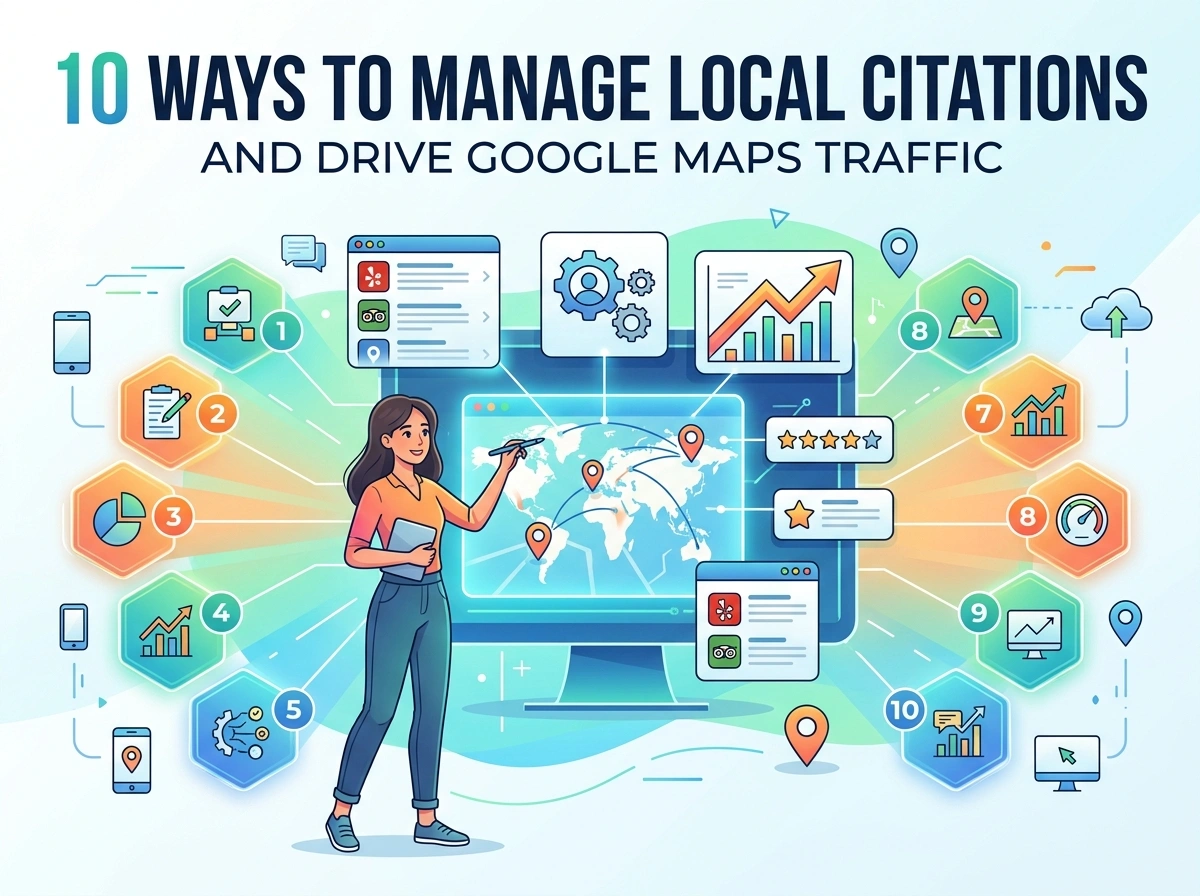
The following approaches move from foundational cleanup to ongoing optimization. Start with the first few if you're new to citation management, then work through the rest as your local presence matures.
1. Audit every existing citation across directories
Before building new citations, find out what already exists. Search your business name in quotes on Google, then check major directories manually. You can also use citation audit tools that scan hundreds of directories at once.
Look for outdated addresses from previous locations, old phone numbers, misspelled business names, and duplicate listings. Document every inconsistency you find, because this audit becomes your cleanup checklist.
2. Fix inconsistent NAP data on high authority sites
Prioritize corrections on the directories that carry the most weight: Google Business Profile, Bing Places, Yelp, Facebook, and Apple Maps. Fixing high-authority platforms first creates a ripple effect, since smaller directories often pull data from larger ones.
Log into each platform, update the incorrect fields, and verify that changes saved correctly. Some directories require verification steps like phone calls or postcards before edits go live.
3. Remove duplicate Google Business Profile listings
Duplicates occur when businesses move, rebrand, or when Google auto-generates listings based on web data. Two or more profiles for the same business split your reviews and confuse ranking signals.
Search for your business on Google Maps and look for multiple pins at the same or nearby addresses. In your Google Business Profile dashboard, you can request removal of duplicates by marking them as "duplicate of another business."
4. Sync citations through an API-based platform
Manual updates work for a handful of directories, but they become impractical at scale. API-based citation management tools push updates to dozens or hundreds of directories from a single dashboard.
When your phone number changes or you move locations, one update propagates everywhere. This prevents the drift that happens when you update some directories but forget others.
5. Build geo-targeted backlinks from local news and civic sites
Geo-targeted backlinks come from locally relevant websites. A mention in your city's business journal or a listing on your state's small business directory tells Google that local sources recognize your business.
Good sources include:
-
Local news coverage: Articles mentioning your business with a link
-
Chamber of commerce sites: Membership directories with business listings
-
Municipal business directories: City or state small business registries
-
Local event sponsorships: Event pages linking to sponsors
6. Add local business schema and entity structured data
Schema markup is code added to your website that helps search engines understand your business information. LocalBusiness schema specifically tells Google your business name, address, phone number, service area, hours, and service types.
This on-site data reinforces what your citations say across the web. When your website schema matches your directory listings, Google sees a consistent entity. Schema also helps AI search platforms like ChatGPT and Gemini read your business details accurately.
7. Close competitor citation and backlink gaps
Gap analysis means finding directories where your competitors are listed but you are not. If a competing plumber appears on HomeAdvisor, Angi, and three local directories where you're absent, they have a citation advantage.
Run a competitor citation audit by searching their business name across directories. Then prioritize getting listed on the directories where they appear and you don't.
8. Verify your profile on AI search platforms
AI search engines like ChatGPT, Gemini, and Perplexity pull business data from citation sources when answering local queries. If someone asks an AI assistant for "the best electrician in Umuahia," the answer depends partly on what citation data exists.
Check whether your business appears correctly in AI-generated answers by asking these platforms about your services. Structured data and consistent citations increase the likelihood of accurate AI recommendations.
9. Feed reviews back into your top citation sources
Reviews and citations reinforce each other. A directory listing with dozens of reviews carries more weight than one with none. Google also cross-references review activity across platforms when assessing prominence, making it essential to boost reviews and ratings across all relevant platforms.
Encourage customers to leave reviews on key directories beyond just Google. Yelp, Facebook, and industry-specific platforms all contribute to your overall citation authority.
10. Monitor citations monthly for drift and new duplicates
Citations degrade over time. Directories update their databases, aggregators push old data, and new duplicates appear. A citation profile that was clean six months ago may have developed inconsistencies.
Set a monthly reminder to spot-check your top 10 directories. Look for any changes to your NAP data, new duplicate listings, or directories where your listing has been removed.
Directories that matter most for service providers
Not all directories carry equal weight. Focus your resources on high-authority sources first, then expand to niche and local listings.
Google Business Profile and Bing Places
Google Business Profile and Bing Places are the primary map platforms and the most direct ranking factors. Google Business Profile verification requires a postcard, phone call, or video verification. Bing Places can import your Google data directly.
Industry-specific directories
Trade-specific sites carry category relevance. HomeAdvisor and Angi matter for contractors. Healthgrades matters for medical providers. Avvo matters for lawyers. Identify the directories specific to your industry and prioritize them.
Local chambers and civic listings
Chamber of commerce directories, city business registries, and local association pages provide high-trust local signals. Many include backlinks to your website, adding authority alongside the citation.
Data aggregators that feed smaller directories
Data aggregators like Neustar Localeze, Foursquare, and Data Axle distribute business data to hundreds of smaller sites. Fixing your information at the aggregator level cascades corrections downstream, saving you from updating each small directory individually.
How to measure Google Maps traffic gains from citation work
Track the following metrics before and after citation cleanup to measure impact:
-
Search queries: What terms trigger your listing in Google Business Profile insights
-
Profile views: How many people see your listing each month
-
Customer actions: Calls, direction requests, and website clicks from your listing
-
Local 3-Pack position: Your rank for target service keywords
Compare numbers monthly. Citation improvements typically show results within two to three months, though competitive markets may take longer.
Citation mistakes that sink service provider rankings
Using call tracking numbers as primary NAP
Call tracking numbers help measure marketing campaigns, but using them as your primary phone number creates inconsistency. Your citations show one number while your website shows another. Use your primary business number in citations and reserve tracking numbers for specific landing pages.
Listing on low-quality spam directories
Not all directories help rankings. Spam directories with no editorial standards, excessive ads, and auto-generated content can harm rather than help. Stick to established directories with real traffic and editorial oversight.
Ignoring duplicate suppression after cleanup
Duplicates often return because aggregators hold old data. One-time removal is not enough. Check quarterly for new duplicates and suppress them before they accumulate reviews or confuse your ranking signals.
Skipping schema and entity signals
Citations alone are incomplete without on-site reinforcement. Missing schema weakens the connection between your website and directory listings. Add LocalBusiness schema to your site and keep it updated when your information changes.
Get your citation and Maps strategy running with Localeadr
Localeadr's citation and authority backlinks service handles the work described in this guide: citation synchronization across 120+ directories, NAP consistency tracking, geo-targeted backlink building from local and civic sources, and verification on AI search platforms.
As a platform where Localeadr provides the ultimate city guide, you can claim your free citation audit or Register on Realinkr to connect with verified local service providers.
Frequently asked questions about managing local citations for Google Maps
How long does citation management take to improve Google Maps rankings?
Most businesses see movement within two to three months after consistent citation cleanup and building. Competitive markets with many established competitors may take longer.
How many directory citations does a local service provider need?
Quality matters more than quantity. Focus first on Google Business Profile, major directories like Yelp and Bing Places, industry-specific sites, and local civic listings before pursuing high volume.
Do citations still matter if my Google Business Profile is already verified?
Yes. Google cross-references your profile data against external citations to confirm accuracy and measure prominence. A verified profile with inconsistent external citations still sends mixed signals.
What is the 80/20 rule in local SEO citation building?
The principle suggests that most of your local ranking gains come from a small number of high-authority directories. Prioritize the top directories that drive the most impact before pursuing volume.
How do I manage citations for a business with multiple service locations?
Each location needs its own verified Google Business Profile and consistent citations. Use location-specific NAP data for each. Avoid mixing location details across listings.