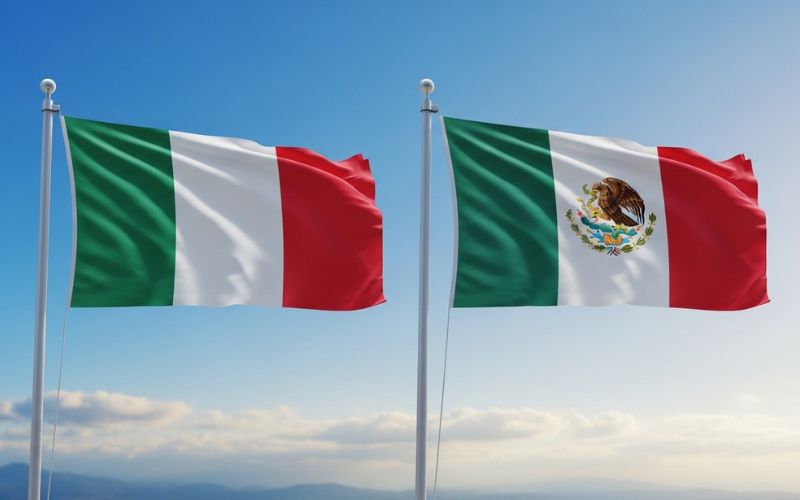
At first glance, the Italian and Mexican flags look almost identical: three vertical stripes of green, white, and red. This resemblance often leads people to wonder if the two countries share a common history behind their national symbols. However, while they may look alike, the Italian and Mexican flags have important differences in colours, proportions, and, most notably, in their unique symbolism.
This article will compare the Italian flag and Mexican flag in detail, from their colours and ratios to their symbolic meanings and unique histories, to give you a full grasp of what makes each national symbol distinct.
Italian Flag vs Mexican Flag: Visual Distinctions in Colour, Ratio, and Emblem
The most immediate differences between the two flags lie in their visual characteristics, focusing on the specific shades of colour, the overall size and shape, and the crucial presence of a central emblem.
The Difference in the Flag Colours
Both flags feature the same three main colours, green, white, and red—but the shades differ significantly. The Italian Flag (Il Tricolore) uses lighter, more vibrant tones: a lighter grass green and a brighter vermillion red. The white stripe is a simple, plain white. In contrast, the Mexican Flag (Bandera de México) features much deeper, richer hues: a darker emerald green and a deep crimson or scarlet red. These shade choices are officially defined in each country's law, giving the Mexican flag a more complex, saturated appearance compared to the bright, minimalist Italian flag.
The Emblem: The Ultimate Distinguisher
The most definitive way to tell the two flags apart is by looking at the white stripe. The Italian flag's white stripe is completely plain; its power is in its simplicity, representing unity and the foundational values of the Republic. The Mexican flag, however, is dominated by its intricate national coat of arms centred on the white stripe. This emblem depicts a golden eagle perched on a nopal (prickly pear) cactus, devouring a rattlesnake. This makes the Mexican flag unique among tricolours and ensures instant identification.
Difference in the Flag Ratios
Another key difference lies in their proportions, which subtly changes the overall feel of the flag's appearance. The Italian Flag uses a common global ratio of 2:3 (height to width), giving it a balanced, slightly squarer look. The Mexican Flag, by contrast, is slightly longer and narrower, with an official ratio of 4:7. This ratio gives the flag a distinct, more elongated profile.
Italian vs Mexican Flag: Deep Dive into Symbolic Meaning
While both flags use the same colour combination, the meaning behind those colours and symbols is profoundly different, rooted in their unique national histories and cultural narratives.
Meaning of the Italian Flag Colours
The Italian flag, or Il Tricolore, has symbolism rooted in unity, nature, and the country's struggle for independence. The colours are largely interpreted as representing the beautiful landscape and the sacrifices made for national unification. The Green signifies the country’s vast plains and rolling hills and is also associated with hope. The White symbolises the snowy peaks of the Alps that border Italy and represents purity and faith. Finally, the Red represents the blood shed by soldiers during Italy’s many wars of independence and unification (Risorgimento), symbolising sacrifice and love of country. The flag's simplicity reflects an emphasis on national cohesion over complex regional or religious emblems.
Meaning of the Mexican Flag and Coat of Arms
The Mexican flag, in contrast, carries deep cultural, historical, and mythological layers. The initial meanings of the colours, adopted after independence in 1821, were distinctly political and religious: Green for Independence, White for the purity of the Catholic Faith, and Red for the blood of national heroes. Today, the modern interpretation is: Green for hope, White for unity and cohesion among Mexicans, and Red for the blood of those who fought for the nation.
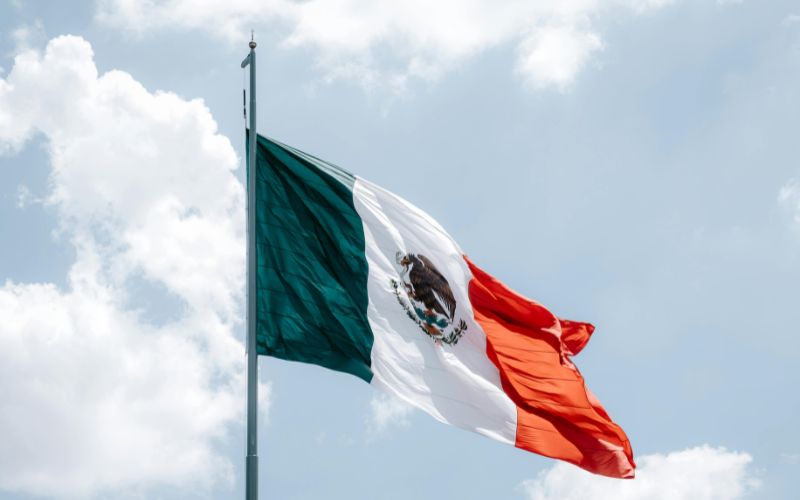
Crucially, the Coat of Arms ties the nation directly to its pre-Hispanic origins. The eagle, cactus, and snake are drawn from a foundational Aztec legend. The Aztec people (Mexica) were commanded by their god of war, Huitzilopochtli, to settle in the place where they saw this specific omen. Upon finding the sign on a small island in Lake Texcoco, they established their capital, Tenochtitlán (c. 1325 CE), which is now modern-day Mexico City. The emblem is thus an enduring symbol of Mexico's cultural heritage and foundation.
Italian Flag vs Mexican Flag: Stories Behind Their Designs
Despite their visual similarities, the historical paths that led to the creation of the Italian and Mexican flags are completely separate, tied to distinct revolutionary and independence movements.
History of the Italian Flag
The Italian tricolour was first adopted in 1797 by the Cisalpine Republic, a northern Italian state established by Napoleon Bonaparte. The design was directly inspired by the French Tricolour (blue, white, red), which was the symbol of the French Revolution. Italian revolutionaries simply replaced the French blue with green, a colour historically associated with Milanese civic guards. The tricolour quickly became a powerful symbol of the movement for Italian independence and unification (Risorgimento) throughout the 19th century. After the abolition of the monarchy, the current, plain tricolour was officially adopted as the national flag of the Italian Republic in 1946.
History of the Mexican Flag
The Mexican flag’s history is rooted in its fight for independence from Spain and its embrace of its indigenous past. After gaining independence in 1821, the first national flag was adopted. It used the tricolour stripes (originally representing Guarantee/Religion, Independence, and Union) and, importantly, included an eagle, a deliberate move to anchor the new nation's identity in its indigenous Aztec roots, establishing a clear break from Spanish colonial rule. The specific design we see today, with the detailed, standardised coat of arms, was officially adopted in 1968 during a period of national standardisation for the Mexico City Olympics. The unique aspect of the Mexican flag is that while the stripes were influenced by revolutionary banners, the central emblem is unique to Mexico's mythology and foundation.
Frequently Asked Questions About the Italian Flag vs the Mexican Flag
Are the Mexican and Italian flags the same?
No, they are distinctly different. They only share a similar tricolour design (green-white-red vertical stripes). The Mexican flag includes a highly detailed coat of arms in the centre and uses darker shades of green and red, while the Italian flag is plain and uses brighter tones and a different ratio.
Why is the Italian flag like the Mexican flag?
The similarity is coincidental rather than intentional. Both flags were inspired by the concept of the tricolour, which originated with the French Tricolour (blue-white-red) during the French Revolution. Thtricolouror concepsymbolisinging revolutionary ideals and national unity, was highly influential across many countries in Europe and the Americas during the 18th and 19th centuries, leading to the independent adoption of the green-white-red pattern by two entirely separate nations.
Which flag was first, Italian or Mexican?
The Italian tricolour appeared in 1797 (Cisalpine Republic), which is earlier than the first Mexican tricolour in 1821 (First Mexican Empire). However, both developed independently under different historical contexts and political pressures.
What does the eagle on the Mexican flag mean?
The eagle on the Mexican flag is the nation's coat of arms, and it represents an ancient Aztec prophecy. The gods commanded the Aztecs to build their city where they found an eagle perched on a nopal cactus, devouring a snake. This site became the foundation of Tenochtitlán, which is now modern-day Mexico City.